
I typically don’t write about tarantulas, but SpiderMentor wouldn’t be SpiderMentor without mentioning Chandra, the chaco golden knee tarantula (Grammastola pulchripes), who was my go-to gal for educational programs and events. Sadly, she passed away this month (October 2023) of old age. With her large size and beautiful markings, she’d easily get everyone’s attention and I used her to attract people to my table. Once at the table, people would get curious about the smaller spiders I brought out like “Chance”, the brown recluse, or “Hazel” the totally buff wolf spider. People would respond to something familiar or something they were curious about and, BAM, they were finding out things about spiders they never knew or were able to re frame a long held misconception.
I bought Chandra from my tarantula collecting friend, Jan, about eight years ago. At the time, I had been doing spider programs and taking Rosa, a Chilean rose hair tarantula, as the star attraction. Rosa was a movie star. She really was! Supposedly, Rosa was used in a Goosebumps movie. I’ve never actually saw it, but that’s what I was told and that’s what I tell everyone! Anyways, as programming opportunities became more frequent, I decided to get a second tarantula with a similarly chill demeanor so Rosa could have a break.
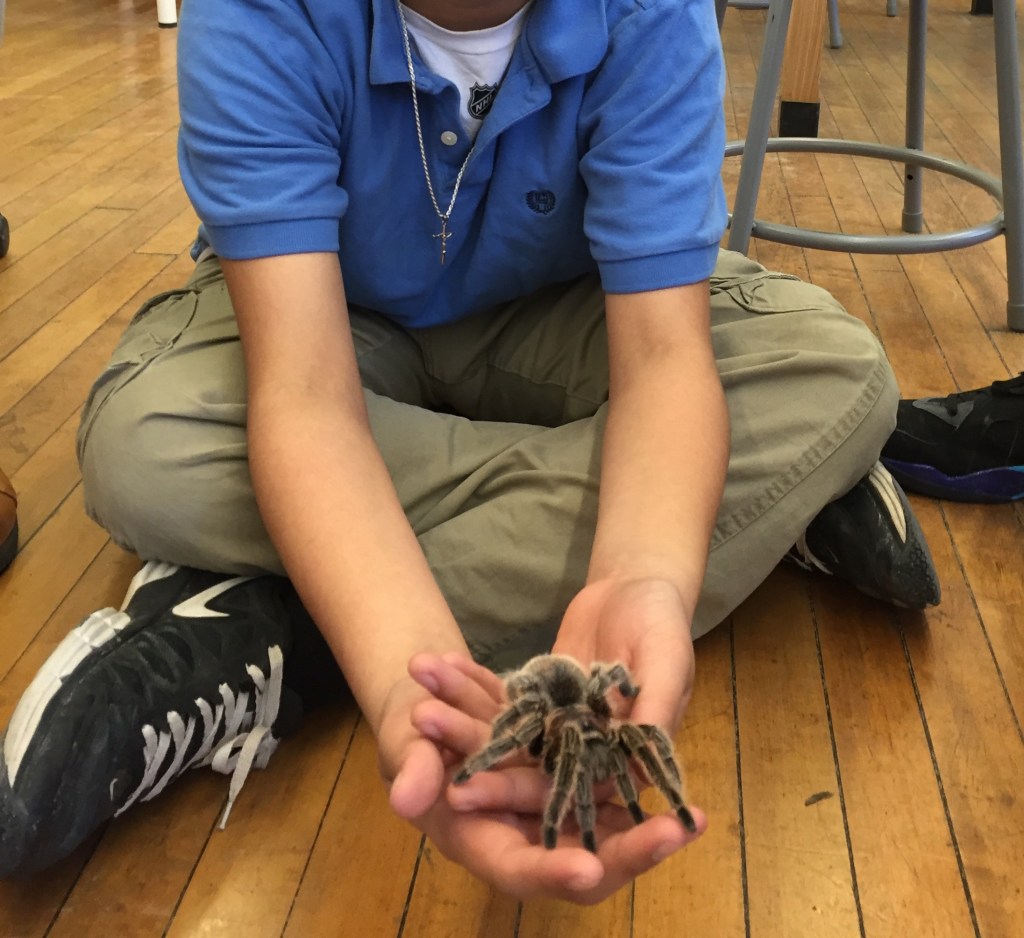
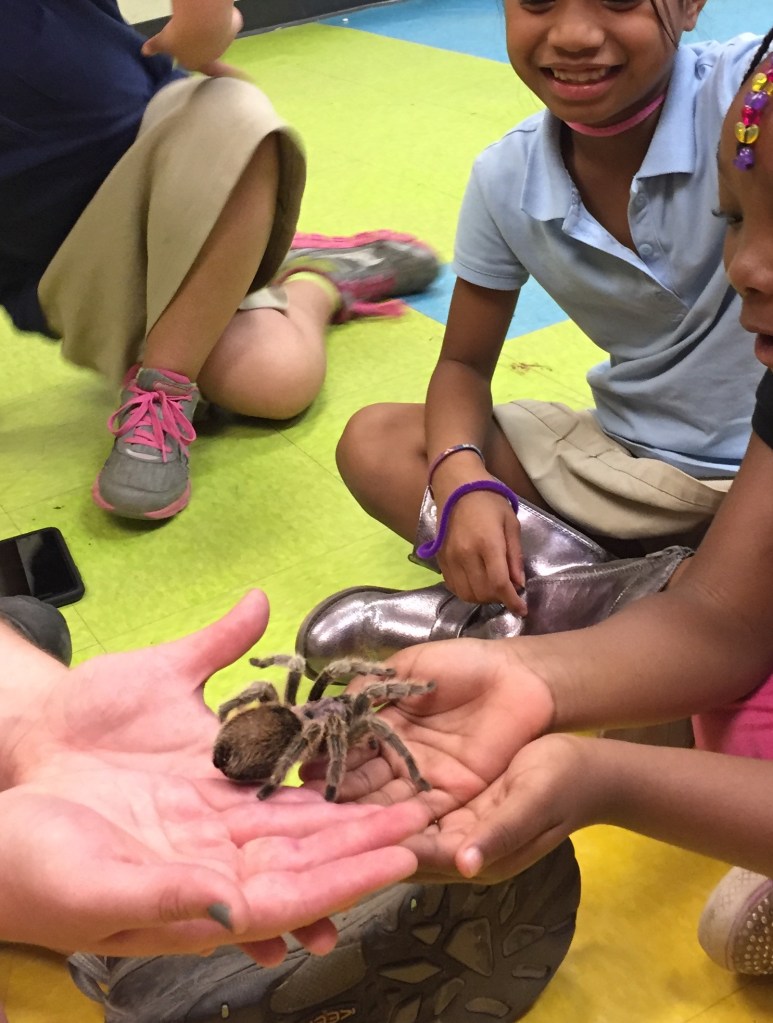
Chandra was bigger than Rosa and was a mature female. At Jan’s house, Chandra (not yet named), slowly crawled across the carpet after she was lifted, by hand, out of the enclosure. I was checking out some other spiders because it’s Jan’s house and she has all different kinds of tarantulas I’ve never seen before. Chandra didn’t seem to mind any of the activity in the room. She’d find a spot and just sit.
When gently coaxed with a relaxed hand, Chandra was completely docile and I fell in love with her poofy, chocolate cream striped tarantulaness! I brought her home and she worked part time with Rosa in schools, auditoriums, cafeterias, and parks, spreading the spider love. Rosa died within a year of getting Chandra, and Chandra took the lead for a few years. In the meantime, I had experimented with other kinds of tarantulas. In the world of spiders, tarantulas (over 900 species) are the largest of them all and fall under the family Theraphosidae. Most tarantulas live in desert or tropical climates. The United States is home to many native species found in the southwest and at least one introduced species in Florida. Pittsburgh has no tarantulas, but we do have purseweb and folding/trap door spiders, which are much smaller cousins.


I had a red rump tarantula, Sophe, for a little while. She was sooooo pretty! Her legs and head were satin black. She didn’t have overly fuzzy legs, but her abdomen (rump) was covered in long red hairs. She was striking! But there were two big issues. One, as an actively burrowing type, she’d constantly dig and hide under the substrate, and, two, when she did come out, she was quick on the defense meaning facing the obstacle with front legs raised in strike pose. All the time. That may not be every red rump tarantula, but you can start to appreciate what makes a rockstar tarantula a rockstar tarantula.

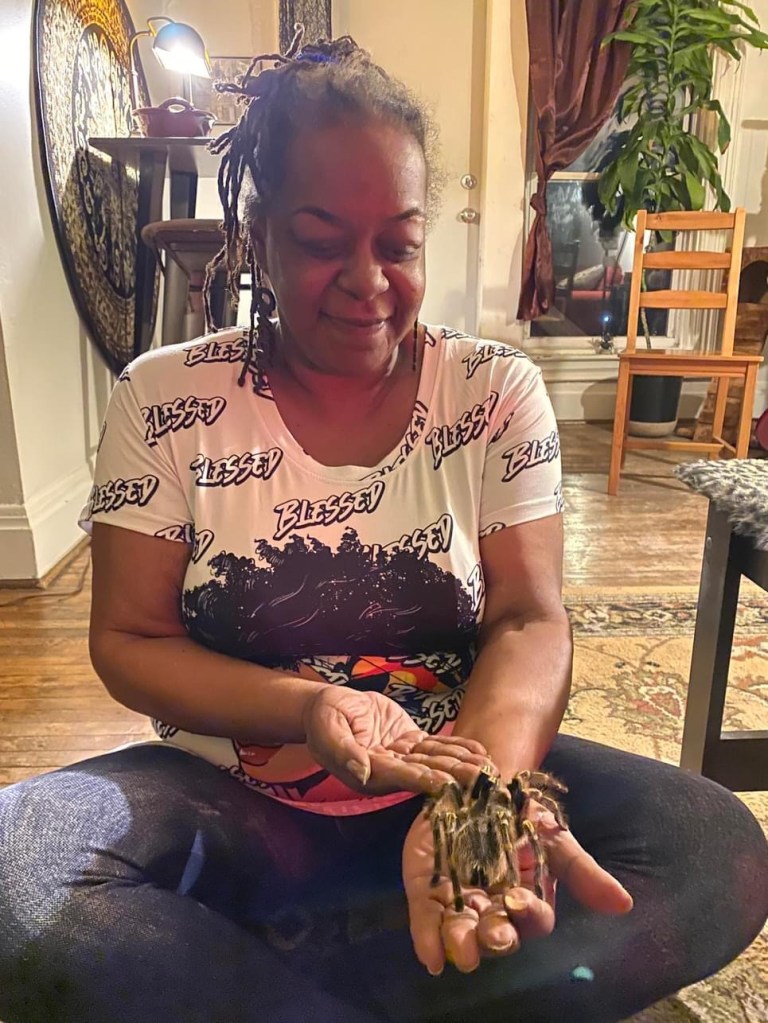
At every event, people ask if I’ve ever been bitten. I have not. They also ask if the spider “knows” me and they do not. I think what’s important is that I know them. Tarantulas, although they have eight eyes, have very poor vision, so they can’t even see what’s going on, let alone know they’re on a hand. They don’t know what a hand is, but they can feel it. Those fuzzy hairs aren’t just there for poofy cuteness, they help the spider navigate what it can’t see. There are hairs and pits and folds all over spiders that allow them to sense temperature, chemicals, pheromones, humidity, and of course vibration. They sense the world completely differently than we do. The tarantulas that are defensive are like that for a reason. In the wild, tarantulas are NOT the top of the food chain despite the scary music accompaniment on most nature documentaries. Many animals, including humans, will kill and eat a tarantula. I keep the high-anxiety ones I have safe (and myself safe) by not handling them. Tarantula venom is not deadly, but some species can inflict quite a painful bite, or so I’ve heard!

In the pet trade, pink-toe tarantulas are pretty common and under $20 so I bought a juvenile pink toe, “Daphne” from Petco thinking this one could be Chandra’s program partner. Pink toe tarantulas are super furry, athletic, and arboreal meaning they live in trees. In contrast, Chandra and Rosa were terrestrial opportunistic burrowers meaning they’ll hide under something if its available -not all-the-time burrowers like Sophe. I wasn’t sure if Daphne was male or female. With spiders, the females always live longer, so if you want a spider for a long time (they can live past twenty years) females are the way to go. Daphne was the smallest tarantula I had, still a large spider, but not palm-sized. Daphne had a blue-ish purple color and was extremely fuzzy with the cutest pink-tipped toes. His/her demeanor towards being handled was tolerant, but sprinty. If you were holding Daphne and made a sudden move or happened to say a word with a hard “p” sound, the spider would get spooked by the air burst and dart a few inches which was quite unsettling for people who weren’t expecting it. I wouldn’t recommend Daphne for first time holders, but teenagers had a lot of fun with her/him. Unfortunately, Daphne died young and I don’t know what caused it except maybe it was something genetic. Pinktoes are very cool and very pretty, so I bought another one, Highland, equally sprinty, who I will pull out on occasion depending on the crowd.


Chandra, again and again, came up aces as I tested other spider personalities. The bar was high. I eventually gained other tarantulas, because they’re so different and colorful and cool…this is how it starts…ANYWAY, there are definitely tarantulas at beginner, intermediate, and advanced handling and care levels. Some are very quick, some defensive (viewing only!), others flick irticating hairs at you on purpose so you’ll leave them alone.
Tarantulas molt their entire lives, even past maturity. Molting is the process of completely shedding the exoskeleton to allow for growth. Maturity meaning all of the reproductive parts are fully functional. Regular spiders, the ones we find most of the time, have a finite number of molts, usually five to nine. It’s only after the final molt that they then have all of their boy and girl parts. Tarantula slings (spiderlings) molt about once a month and get noticeably larger each time. Once they’re older, they slow down and molt about once a year. The molting process is very taxing and if not done successfully, the spider can be deformed and will most likely die. Chandra’s molts were now about a year apart and her energy began to dwindle little by little afterwards. She would look weak and rubbery for weeks after a molt, refusing food. She’d bounce back eventually, but after her last molt (October 2022), she never fully recovered. It was the only time I actually SAW her molting. It took two hours and was painful to watch. I thought for sure she wasn’t going to make it. She pulled through, literally, but her abdomen never plumped back up and she definitely wasn’t eating as much as she used to.
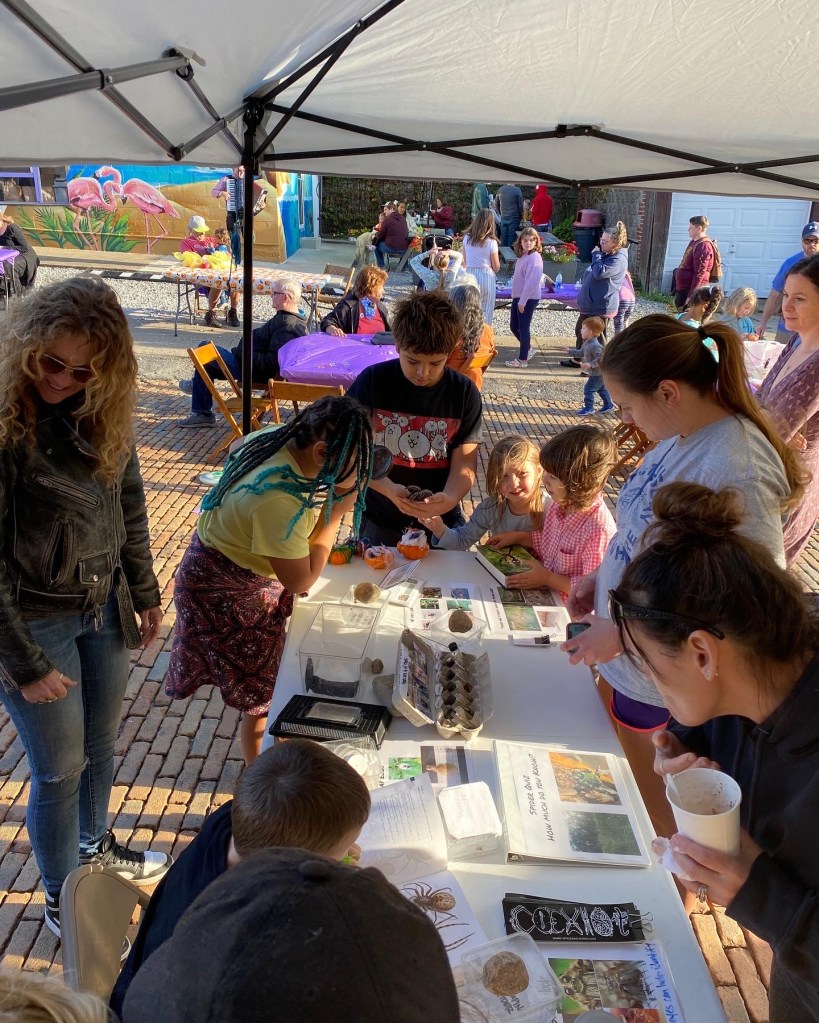
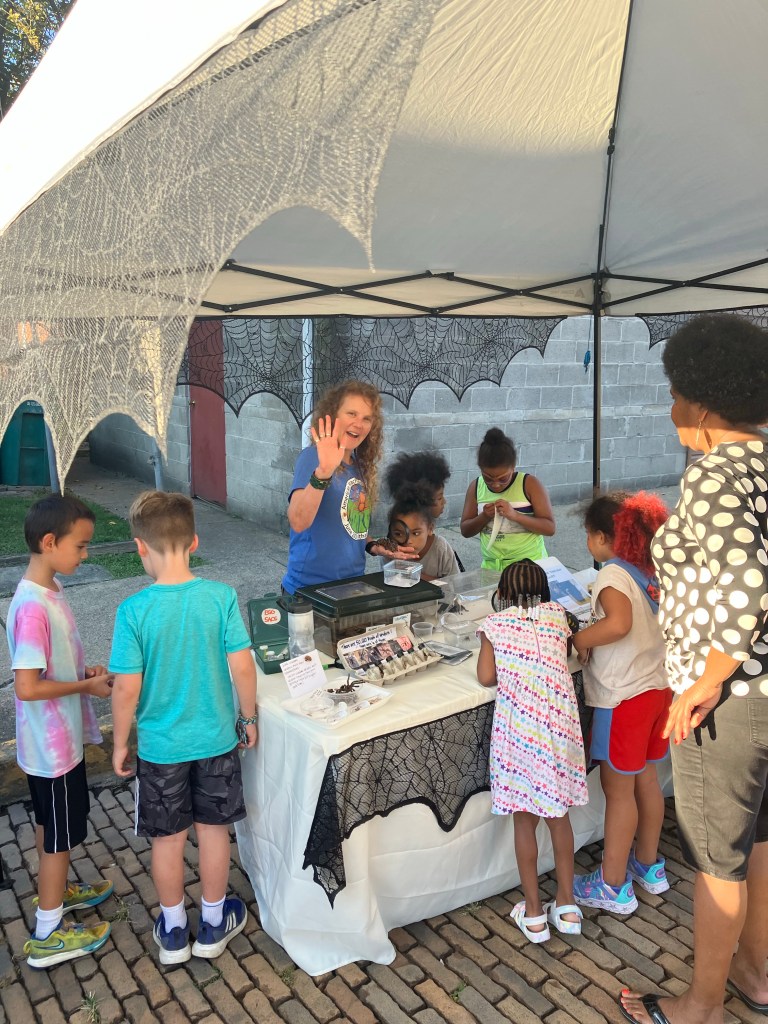
Seeing Chandra decline, I sought out another Rose hair, Schenley, to help take some of the performing pressure off of her. In fact, Schenley took over completely for awhile. Chandra’s last show was for the Swissvale Dari Delite end-of-season celebration. The SpiderMentor tent was jammin’ with kid after kid holding Chandra or Schenley depending on whose shift it was. Chandra calmly posed in the palms of dozens of people as they smiled for photos. Some wore new badges of bravery, having never held a spider ever in their lives. Some were entertained as they watched their friends do it. Some were ambivalent at first, but then became increasingly confident after having looked over all of the spider facts and info on the table. It was a well-woven operation.


I didn’t keep a resume for Chandra, but I can tell you she got around to many events. She was an awesome teacher and helped countless people get over their fear of spiders. Chandra was lovingly buried among the wild flowers in the school garden by a small group of bug-loving fourth graders who knew her. It was very sweet as they decorated a stone, said a few fond words, and then adorned the site with trinkets and petals. I have mourned the passing of every spider I’ve kept, but this one ached a bit more than usual.


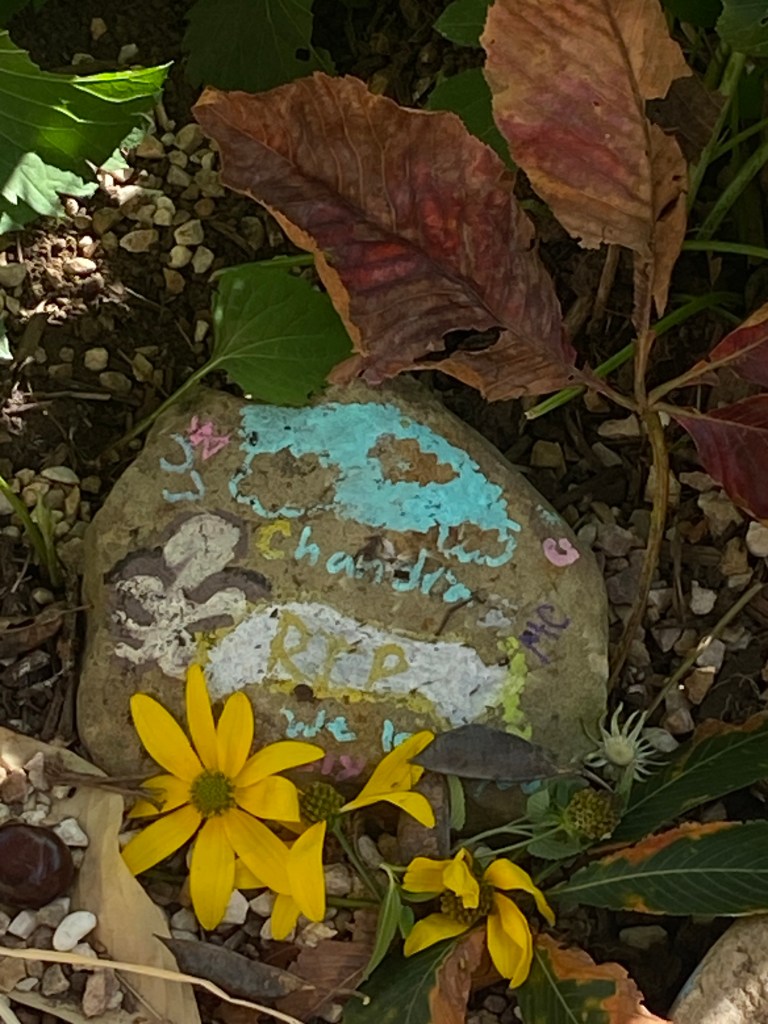
Thank you Chandra, for your many years of service. You were truly a rockstar! We will miss you!

 SpiderMentor
What a delightful story. We had a tarantula in our biology lab at OSU Marion for years. It was one of a group that was confiscated at customs as part of an enforcement action against illegal import. She was very gentle and cooperative for a variety of behavioral observations, as well as a great ambassador for spiders in general. We got her as an adult, so I don’t know how old she was when she died, but she lived in the lab for many years. The reason I’m writing this is to remind readers (what spidermentor already knows, and has written about) that they should check the provenance of a spider before purchasing. Many species can be bred in captivity, and those should be the target of your search. We don’t want to support the exploitation of wild populations of any spider, particularly long-lived species with relatively low population density, like most mygalomorphs, including tarantulas.
LikeLike
I really appreciate you mentioning this! Yes, yes, yes!
LikeLike
Oh, Amy. What a lovely tribute. I’m so sorry for your loss – I cried a lot when my Bellatrix passed (also a Chilean Rose). She was a rescue, so I never knew how old she really was. Also a well behaved girl; tho we did not ever handle her in class she was a delight to observe.Frances
LikeLike
Thank you Frances. Sorry about Bellatrix! It’s amazing how much we can become attached to our beloved arachnids! ❤️🕷️
LikeLike