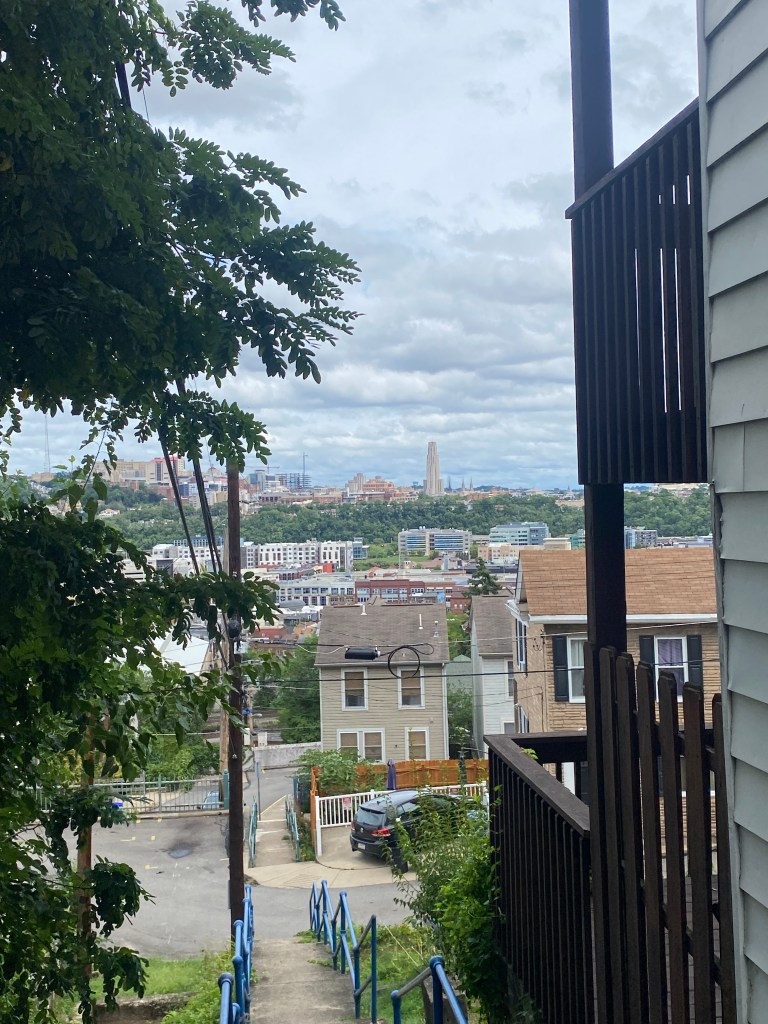
Pittsburgh, with all of our hills and valleys, is rumored to have the most public, city steps of any city in the country. As we zoom into the south shore of the Monongahela River, most of the steps are concentrated in what is known as the Southside neighborhood. My home-hood, Beechview, comes in second place. Just sayin’. Southside makes a big deal about their hilly landscape by hosting yearly Step Treks which are really fun and I’ve participated in many.
In August, I did a mini, unofficial step trek with my niece and nephew, ages eight and six. We kept it light, starting at the bottom of Oakley Street (a “street” made of steps) heading up the slopes ’til we couldn’t go up anymore. The route zigzagged between concrete and wooden steps with the occasional, actual road that had steps instead of a sidewalk. We made sure to stop and check the slowly emerging view behind us. It was during one of these stops, looking at the tallest building on Pitt campus in the distance (the Cathedral of Learning), that my niece found Spintharus flavidus, one of the Smiley-faced spiders.

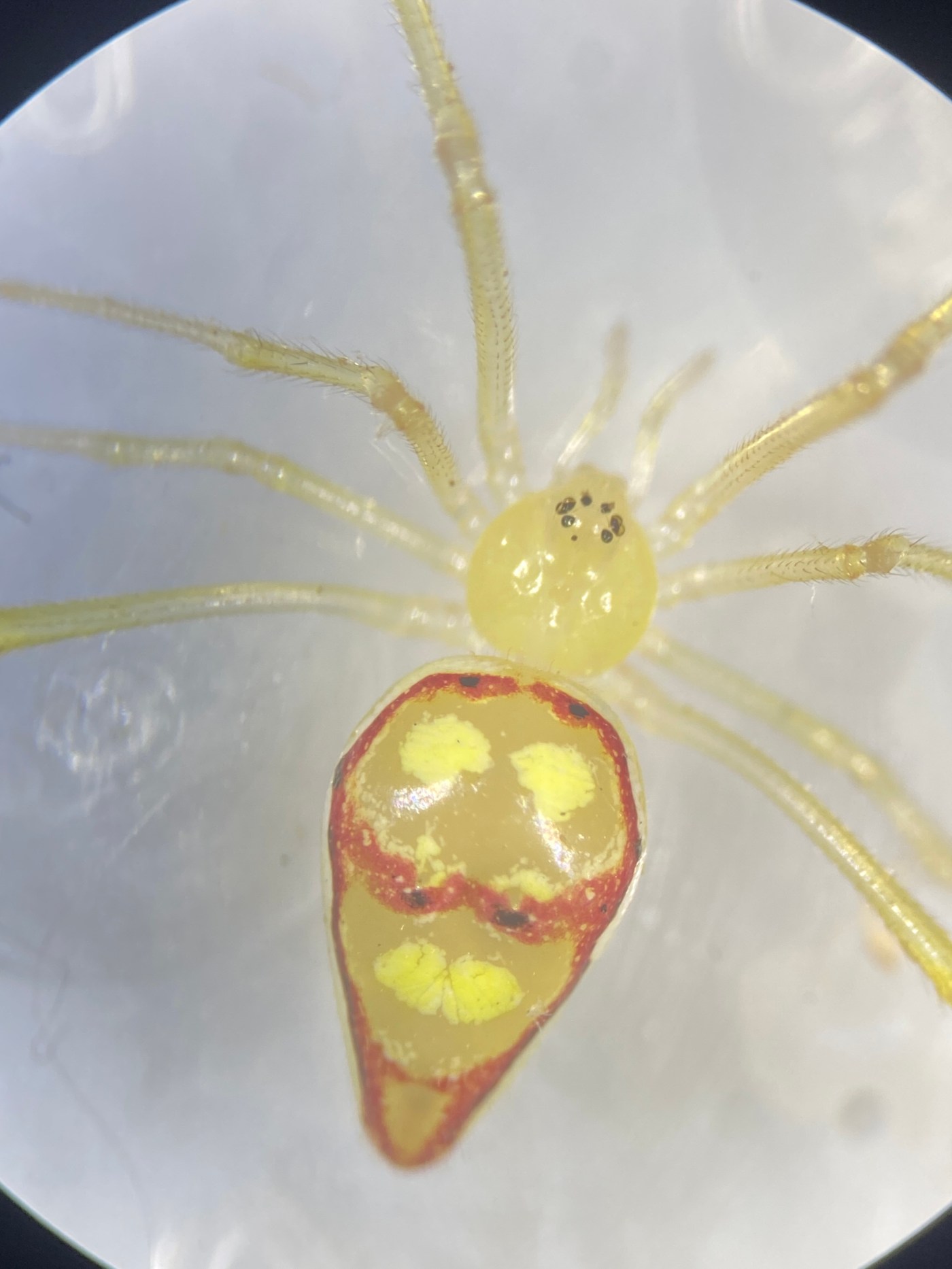
Typically, these spiders are found among foliage, but this one was hanging below the metal railing along the side of the steps. Smiley-faced spiders are smallish, about four to five millimeters, head to butt. Including the legs, they would fit on a U.S. nickel. It was the bright, ornate markings that allowed me to identify it. The overall color is a pale, almost translucent yellow. The abdomen has darker yellow blotches and black dots surrounded by a red border. Its front and back pairs of legs have a red ring at one of the “knee” joints. There aren’t any markings on the head or belly, at least on the one we found. There aren’t any thick spines (macrosetae) or fuzzy hairs. It’s a very sleek, shiny looking spider. And check out the oval eye pattern! There are eight eyes, with the two lateral pairs nearly touching.
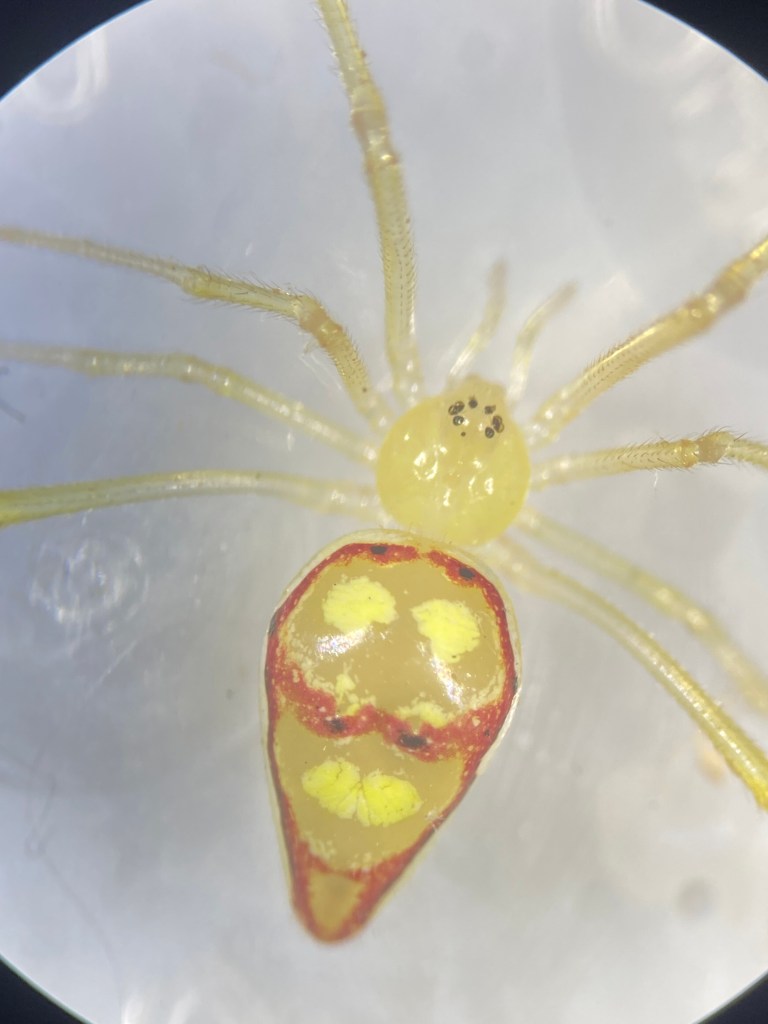
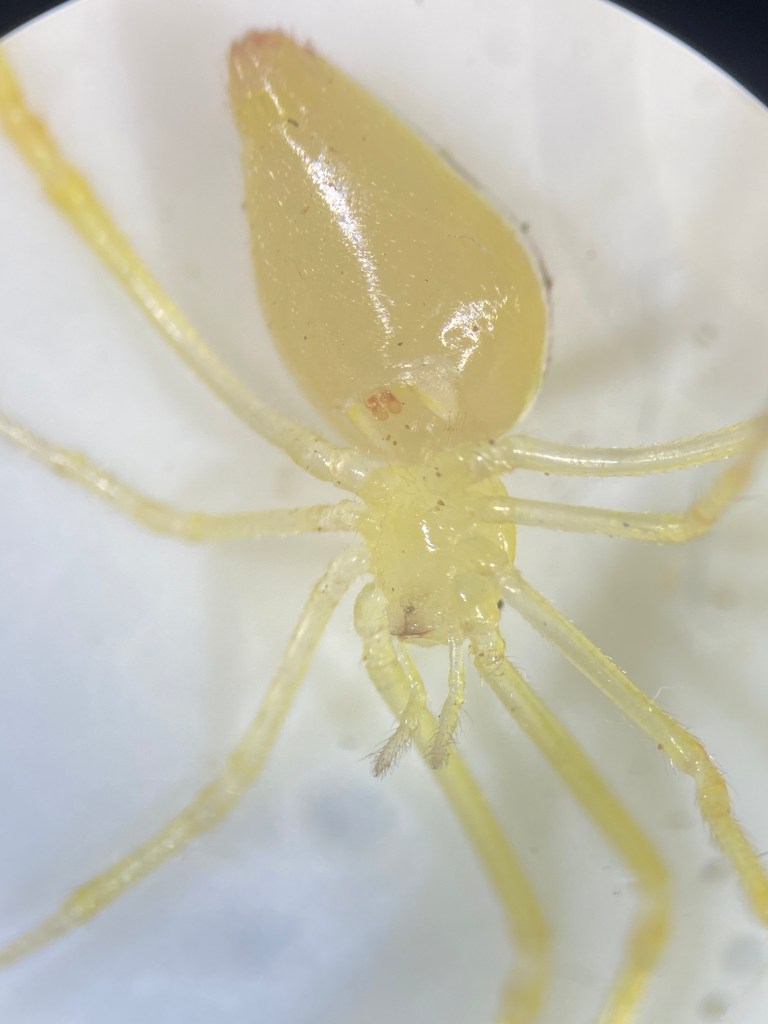
Not to be confused with Theridion grallator aka the Happy face spider (only found in Hawaii), Spintharus flavidus is found in the eastern states down through Central America and the Caribbean Islands into South America. A few different species exist, but only ONE species is found in the U.S. so no need to pull out the microscope for a solid ID.
Although ID was easy, I realized how much I didn’t know about this unique spider! I had seen this spider only once before, but it was many years ago, on the underside of a hemlock branch somewhere outside of the city. I took a photo and used it for my spider wall calendar. Funny, the smiley-face spider was the feature photo for this month (August 2024)!
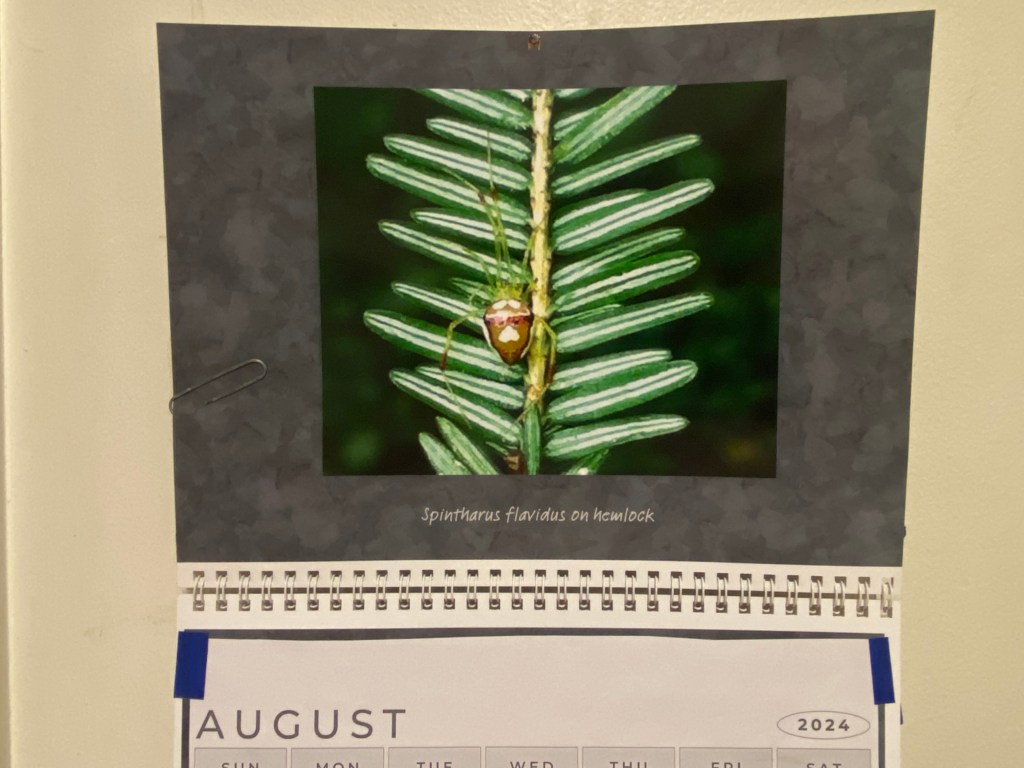
I was curious about the life history of Spintharus flavidus. How does it catch prey? Is it a specialist focusing on ants, or a generalist, eating any ‘ole thing that passes by. What kind of web does it make? There wasn’t much info in the literature, so I kept the spider for a little while to get to know it better.
The Spinthrarus genus (Smiley-faced spiders) belongs to the Theridiidae family, aka the comb-footed or cobweb spiders. The Theridiidae family is large and extremely diverse, but most of them make messy, three dimensional webs. Spintharus flavidus does make a web, but it’s hard to see. I’ve read that it’s a simple “H” shape with the spider holding the vertical lines of the “H” together. In captivity, the spider was kept in a thirty-two ounce, modified deli cup with mesh on the top and sides. There was a branched twig for climbing and attaching silk. Whenever I checked on the spider (usually during the day), it was upside down on the lid or on the sides of the container. It has a kind of knobby-kneed, peculiar posture. I did not see any H-web, but that doesn’t mean there wasn’t one.
For prey, I tried ants, which were ignored, and fruit flies. The spider did respond to a fruit fly by quickly turning its rear toward it as if to start wrapping with silk. The darn fly got away before the spider could get ‘im. I was not able to witness the spider actually catch any prey and I eventually made the trek back to the Oakley Street steps, where I assume there is a population, and released it into the overgrown knotweed. I wished I couldn’t seen it eat! So mysterious!


Diving into the literature for more information on these guys opened up a rabbit hole. The late Herbert Levi, a renowned arachnologist and taxonomist, had described Spintharus flavidus as a very diverse species with a very broad range. He noted a lot of variation in the species’ anatomy, like the colors and shape of the abdomen, whether parts of the eye region were on a raised hump or not, and he described slight variations in the male and female genitalia. This was based on looking at the physical anatomy of old, dead, preserved spiders from various collections under a microscope. He examined and reexamined specimens noting the variations as a “problem” and that more needed to be observed. Even though he knew something was up, many of the variants, spanning from eastern U.S. through central America and into Peru and northern Brazil, were lumped in one species, Spintharus flavidus. This was how it stayed for decades until Dziki et al., 2015, analyzed molecular data from freshly caught Spintharus spiders in the Caribbean. They bypassed the confusing physical characteristics and went straight for the DNA. The study concluded the eccentric, widespread Spintharus flavidus was not a bunch of variants of one species, but were FIFTEEN different species!
Igni Agnarsson was one of the authors in Dziki paper. A few years later, in 2018, Agnarsson, et al. published a paper describing these new species AND dubbed the genus “Smiley-faced spiders”. When a new species is described, the author gets to come up with the scientific name. Most taxonomic names are in Latin and reflect locality or some trait of the animal. For example, flavidus is Latin for golden-yellow. Agnarsson and colleagues named these new Spintharus spiders after people. You might recognize some of them: Spintharus leonardodicaprioi, S. michelleobamaae, S. davidbowiei, and S. davidattenboroughi are a few. I really got a kick out of that!
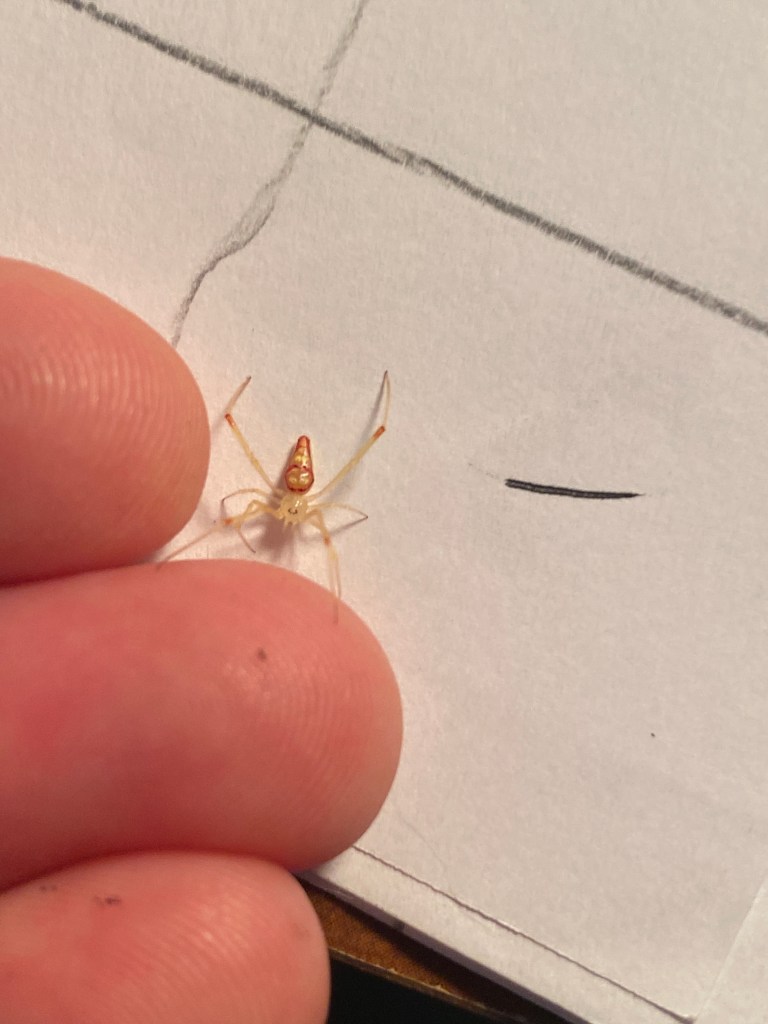
With this info, I’m not sure if what we found in the Southside of Pittsburgh is Spintharus flavidus or an undescribed species. A whole new revision using molecular analysis may be coming in the near future affecting the only U.S. smiley-faced spider we thought we had! I am imagining what names we could give them. The International Code of Zoologic Nomenclature states under Article 25, Recommendation 25C that “Authors should exercise reasonable care and consideration in forming new names to ensure that they are chosen with their subsequent users in mind, and that, as far as possible, they are appropriate, compact, euphonious, memorable, and don’t cause offense.” We should be careful with the politician names…Americans get easily offended these days, but if we’re sticking with names, I vote for S. misterrogersi or maybe S. jacklamberti or S. teenyharrisi…
This whole dive into what I thought was a simple ID and story about an interesting spider turned into a many tiered adventure! I found the research to be extremely interesting. Yinz should look into the sources below because there’s more to it than I can cover here. Referring back to the city steps with their ups and downs, and eventually a destination, the area of identification via molecular analysis in partnership with old school morphological taxonomy should put the smiley-faced spider, and all its variants, into better view.

Sources:
Agnarsson, I., Van Patten, C., Sargeant, L., Chomitz, B., Dziki, A. & Binford, G. J. (2018). A radiation of the ornate Caribbean ‘smiley-faced spiders’, with descriptions of 15 new species (Araneae: Theridiidae, Spintharus). Zoological Journal of the Linnean Society 182(4): 758- 790. doi:10.1093/zoolinnean/zlx056
Dziki A, Binford GJ, Coddington JA, Agnarsson I. 2015.
Spintharus flavidus in the Caribbean-a 30 million year biogeographical history and radiation of a ‘widespread species’.
Peerj 3: e1422 https://doi.org/10.7717/peerj.1422
LeMay, G. A. & Agnarsson, I. (2020). New species of smiley-faced spider Spintharus (Araneae, Theridiidae) from Brazil, and comments on unobserved diversity in South America. ZooKeys 915: 17-24. doi:10.3897/zookeys.915.4756
Levi HW. 1954a. The spider genera Episinus and Spintharus from North America, Central America and the West Indies (Araneae: Theridiidae). Journal of the New York Entomological Society 52: 65– 90.
Levi HW. 1963a. The American spider genera Spintharus and Thwaitesia (Araneae: Theridiidae). Psyche (Cambridge) 70: 223–234

 SpiderMentor
Leave a comment